Travel CRM Software for Travel Agencies & Tour Operators
Manage leads, enquiries, quotations, follow-ups and customer relationships in one travel CRM built for agencies and tour operators.
What Is Travel CRM Software?
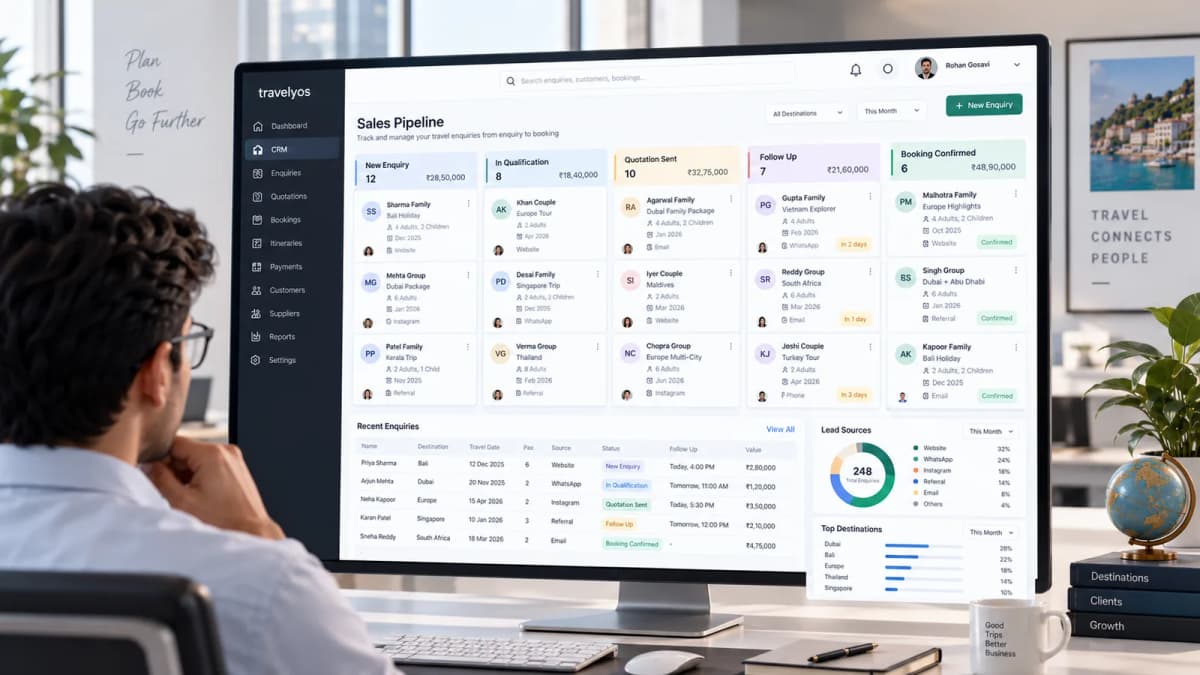
Travel CRM software is a customer relationship management system designed around the sales and customer workflows of travel agencies and tour operators. Instead of managing enquiries, customer details, quotations and follow-ups across separate tools, a travel CRM gives your team one place to manage the customer journey.
A generic CRM tracks contacts and opportunities. A travel-focused CRM understands the journey: a traveller enquires about a destination, asks for a customized itinerary, receives a quotation, asks questions on WhatsApp, makes changes, and eventually books.
TravelyOS Travel CRM brings leads, customer information, enquiries, quotations, follow-ups and sales activity into one system built around the way travel businesses actually work.

TravelyOS Travel CRM at a glance
Lead Management
Organize and track travel enquiries
Customer Profiles
Keep customer information and activity together
Sales Pipeline
See opportunities and their current stage
Quotations
Manage the transition from enquiry to proposal
Follow-Ups
Keep opportunities from being forgotten
Connect communication with the sales workflow
Lead Sources
Understand where enquiries originate
Conversion Tracking
Monitor progress from enquiry toward booking
Why Do Travel Agencies Need a Travel CRM?
Travel sales rarely happen in one conversation.
A customer might discover an agency through a website, send a WhatsApp message, ask for a quote, disappear for three days, return with a different travel date, and then ask for a revised package.
When that information lives in different places, opportunities are easy to lose.
A travel CRM gives your team a structured way to manage that journey.
TravelyOS brings those sales activities together so your team can work from a shared view of the customer journey.
The point isn’t to add another system to your business. It’s to reduce the number of places your team needs to check.
With TravelyOS, your team gets:
Enquiries in one place
A centralized environment for travel leads and enquiries
Follow-ups you can see
Track opportunities that need another conversation
One customer, one history
Customer details and activity kept together
Quotations in the flow
Quotation activity connected to the opportunity
Clear ownership
A defined way to assign and work every enquiry
A structured pipeline
See what is moving, what is waiting and where to act
Source visibility
Connect lead source to enquiry to conversion
Know what needs attention
A shared view of the customer journey
How Does TravelyOS Travel CRM Work?
TravelyOS is built around the flow of a travel enquiry rather than a generic sales pipeline. The CRM gives your team a structured place to manage each step of that journey.
Capture Travel Enquiries
The first step is getting enquiries into a system where they can actually be managed.
Instead of relying on individual team members to remember every conversation, TravelyOS provides a centralized environment for managing travel leads and enquiries.
Your team can then see which opportunities are active, which require follow-up and which have progressed further through the sales process.
Organize Leads in One Pipeline
A travel sales pipeline gives your team visibility into opportunities at different stages.
Instead of asking:
“Did anyone follow up with this customer?”
your team can work from a structured pipeline.
The pipeline can help organize opportunities according to the stage of the sales journey.
That makes it easier for managers to see what is moving, what is waiting and where the team needs to take action.
Manage Customer Profiles
Travel customers are more than names and email addresses.
Their enquiry may involve destinations, dates, travellers, preferences, previous conversations and quotation details.
A centralized customer profile helps your team keep relevant information connected to the customer instead of rebuilding the context every time someone speaks with them.
One customer. One history. One place for your team to work from.
Create and Follow Up on Quotations
A quotation is often where travel enquiries either move forward or go cold.
TravelyOS connects the sales workflow around the quotation and follow-up process so your team can continue managing the opportunity instead of treating the quotation as an isolated document.
This is particularly useful when customers request changes.
A revised travel date or itinerary shouldn’t mean starting the sales process from scratch.
Keep Follow-Ups From Falling Through the Cracks
Travel customers don’t always book immediately.
Some need another conversation. Others compare options. Some simply need time.
That makes follow-up a critical part of travel sales.
A structured CRM helps your team keep track of opportunities that need attention rather than relying entirely on memory, spreadsheets or individual reminders.
Good follow-up is not about sending more messages. It’s about knowing which customer needs attention and why.
Track Lead Sources and Sales Activity
Knowing where enquiries come from helps travel businesses understand which acquisition channels are producing opportunities.
Depending on your implementation and integrations, TravelyOS can be used as the central sales environment for managing leads generated through your broader acquisition channels.
This gives your team a clearer connection between:
Lead source → enquiry → sales activity → quotation → conversion
That visibility becomes especially useful as marketing activity grows.
Keep WhatsApp Communication Connected to the Sales Process
For many travel businesses, WhatsApp is part of the sales process—not just a support channel.
A customer may ask for a package, discuss dates, request a quotation and follow up entirely through messaging.
TravelyOS includes WhatsApp automation as part of its broader travel-business platform, allowing communication workflows to sit alongside the CRM and operational workflow.
Where automation is appropriate, teams can use structured communication for activities such as enquiry responses, follow-ups, payment reminders and travel-related customer communication.
What Can You Manage With TravelyOS CRM?
TravelyOS brings several parts of the travel sales process together.
Travel Lead Management
Keep travel enquiries organized instead of allowing prospects to disappear into disconnected conversations.
Track opportunities through the sales process and give your team a clearer view of active leads.
Customer Management
Keep customer information and sales activity connected so your team has context when handling enquiries and follow-ups.
This is particularly useful when multiple team members interact with the same customer.
Sales Pipeline
See opportunities according to their position in the sales process.
A structured pipeline makes it easier to understand what is active, what requires attention and where opportunities are progressing.
Travel Enquiries
Travel enquiries often contain more context than a standard sales lead.
The destination, dates, traveller requirements and requested package can all influence what happens next.
A travel-specific CRM gives your team a workflow designed around those enquiries.
Quotations
Move from enquiry to quotation without losing the customer context.
Quotation activity should remain connected to the broader sales process so your team can continue following the opportunity.
Follow-Ups
Keep track of opportunities that need another conversation.
The objective is not simply more follow-ups. It’s better visibility into when and why a customer should be contacted.
WhatsApp Communication
Connect customer communication with the broader sales workflow.
For travel agencies where WhatsApp is a major enquiry channel, this can help reduce the gap between conversations and CRM activity.
See it with your own workflow
Walk through your current lead-to-booking process with the TravelyOS team.
Why Use a Travel-Specific CRM Instead of a Generic CRM?
A generic CRM can be useful for managing contacts, deals and sales activities. But travel sales have their own workflow.
A customer doesn’t simply ask for a product price. They may ask for a destination, travel dates, number of travellers, hotel preferences, activities, transportation and a customized itinerary — and the sales process often continues through several revisions before a booking is confirmed.
TravelyOS is not positioned simply as a contact database. It’s part of a broader operating system for travel businesses.
A travel CRM should understand the context around:
| Generic CRM | Travel CRM |
|---|---|
| Contact | Traveller/customer |
| Sales opportunity | Travel enquiry |
| Deal | Trip/package opportunity |
| Sales activity | Customer follow-up |
| Proposal | Travel quotation |
| Sales pipeline | Travel sales pipeline |
| Communication | Travel enquiry conversations |
| Conversion | Booking opportunity |
Who Is TravelyOS Travel CRM For?
TravelyOS is designed for travel businesses that need more structure around sales and customer management.
Travel Agencies
Manage enquiries, customers, quotations and follow-ups from a centralized CRM environment. For agencies handling enquiries across multiple channels, having one sales workflow can make team coordination easier.
Explore travel agency solutions →Tour Operators
Tour operators often need CRM functionality alongside itinerary, departure, room allocation, transport, payments and operational workflows. TravelyOS connects CRM with those broader travel operations.
Explore tour operator software →B2B Travel Businesses
B2B travel sales can involve agencies, partners and sub-agents rather than only direct travellers. TravelyOS has a dedicated B2B CRM solution for businesses with those requirements.
Explore B2B travel CRM →B2C Travel Businesses
For direct-to-consumer travel sales, the CRM can help organize incoming enquiries, customer conversations, quotations and follow-ups.
Explore B2C travel CRM →How Does TravelyOS Fit Into the Complete Travel Workflow?
This is where TravelyOS goes beyond a standalone CRM. The CRM can sit at the beginning of a broader travel-business workflow.

- 1Lead
- 2Customer enquiry
- 3Sales pipeline
- 4Quotation
- 5Follow-up
- 6Booking
- 7Payment
- 8Itinerary / Operations
- 9Hotel & Room Allocation
- 10Transport
- 11Trip Profitability
Filled steps are managed in the CRM; the rest connect to booking and operations.
The exact modules you use depend on your business model and TravelyOS configuration. But the underlying idea is important:
Your sales team should not have to operate in one system while your operations team works somewhere completely separate.
A travel business is one workflow, even when different teams handle different stages.
How Can Travel CRM Improve Sales Conversion?
A CRM doesn’t magically create bookings.
What it can do is make the sales process more visible and more manageable.
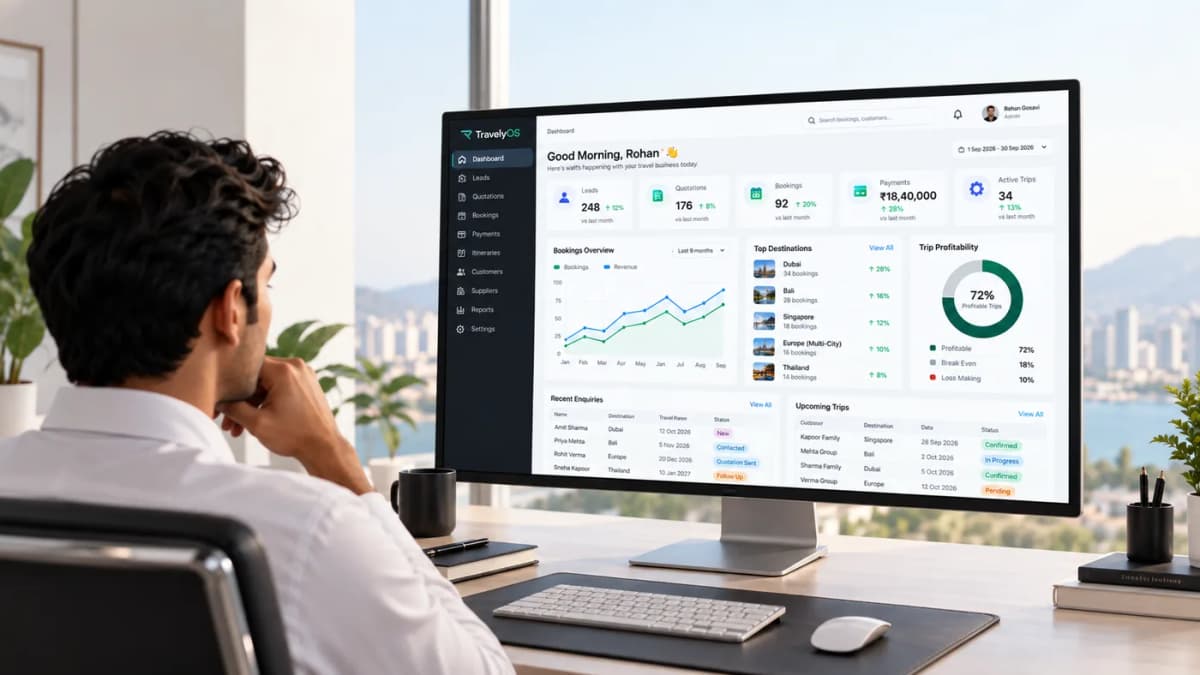
When your team can see active enquiries, follow-ups, quotations and customer history in one place, it becomes easier to identify opportunities that need attention.
For example, imagine this sequence:
- MondayA customer requests a holiday quotation.
- TuesdayThe customer asks for a revised hotel option.
- WednesdayThe quotation changes.
- FridayThe customer hasn’t responded.
Without a structured workflow, that opportunity can easily disappear into someone’s inbox or WhatsApp history.
With a CRM, the opportunity remains visible.
That’s where CRM value becomes practical: fewer forgotten opportunities and better visibility into the sales pipeline.
How Can You Move From Excel to a Travel CRM?
Excel can work surprisingly well when a travel business is small. Then the spreadsheet grows.
One person owns the latest version. Another has a separate copy. Follow-up dates live in someone’s notes. Customer conversations live in WhatsApp.
Eventually, the spreadsheet becomes less of a system and more of a daily obstacle. Moving to a CRM gives the business a centralized environment for managing leads and customer relationships.
A practical migration process looks like:
- Identify the customer and lead data you actually need.
- Clean duplicate and outdated records.
- Define your sales stages.
- Decide how enquiries should be assigned.
- Map your quotation and follow-up process.
- Import relevant customer and lead information.
- Train the team around the new workflow.
- Measure adoption and conversion activity.
Don’t migrate every column just because it exists.
Move the information your team actually needs to sell and serve customers.
How Does TravelyOS Connect CRM With Other Travel Operations?
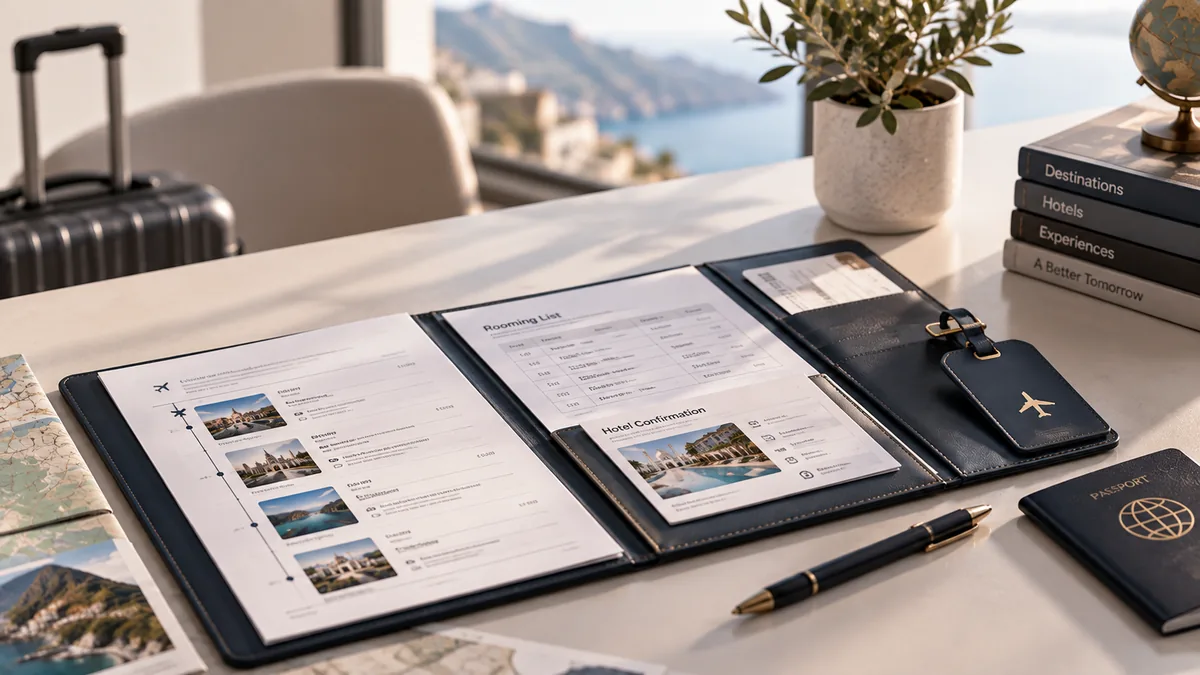
A CRM becomes more valuable when the information collected during sales can support what happens after the customer decides to book.
TravelyOS is positioned as a broader travel-business platform that includes capabilities around areas such as:
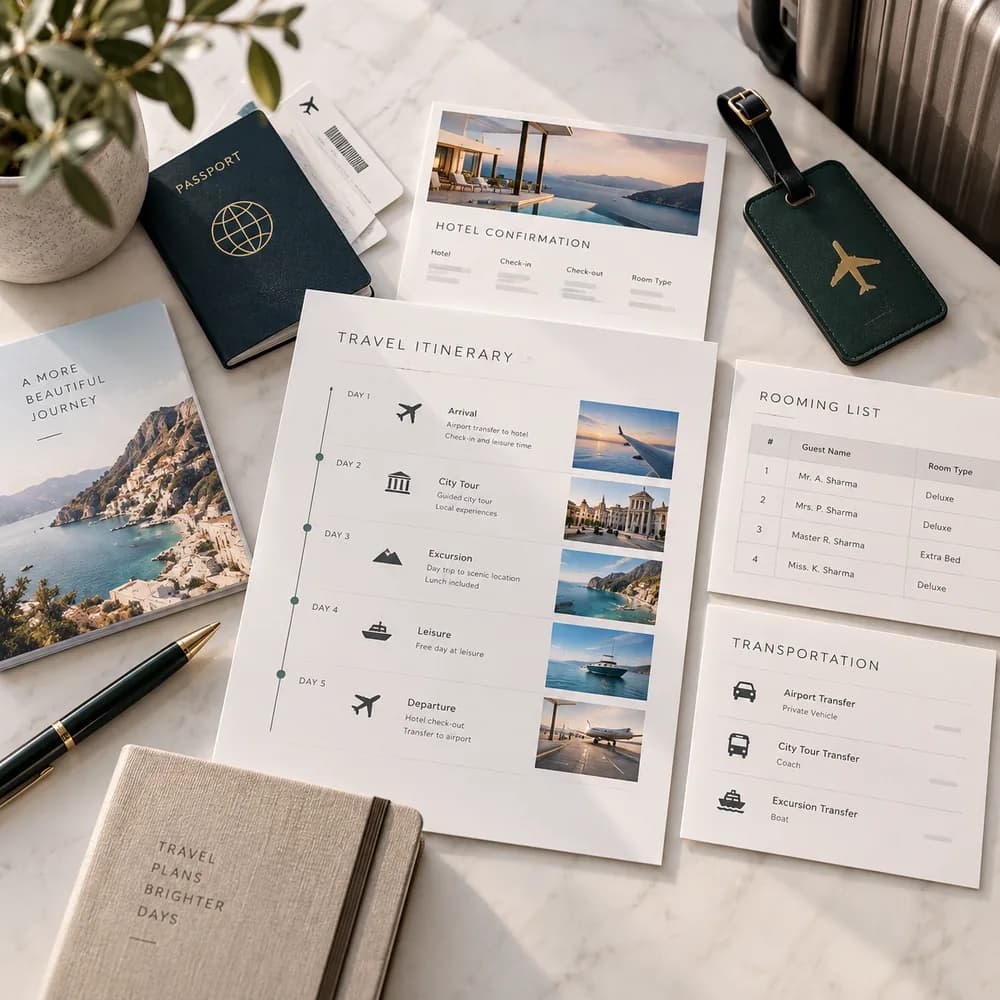
- Itinerary management
- Hotel and room allocation
- Transport management
- Back-office operations
- Payments
- Analytics
- WhatsApp automation
That means the CRM can be viewed as part of the larger TravelyOS operating workflow rather than an isolated sales application.
What Makes TravelyOS Travel CRM Different?
The biggest distinction is the context. TravelyOS is built specifically around travel businesses rather than adapting a generic CRM to a travel workflow. That means the CRM sits alongside the operational capabilities travel companies need as they move from enquiry to booking and delivery.
TravelyOS brings together:
Sales
Leads, enquiries, customers, quotations and follow-ups.
Communication
WhatsApp and customer communication workflows.
Operations
Itineraries, room allocation, transport and back-office processes.
Finance
Payments, invoicing and profitability-related workflows.
Analytics
Visibility into sales and travel-business performance.
The result is a platform designed around the actual journey of a travel business.
What Should You Look for in Travel CRM Software?
Before choosing a travel CRM, don’t judge it only by the number of features listed on the pricing page.
Ask whether the software fits the way your team actually sells travel.
Use this checklist:
- Does it centralize travel enquiries?
- Can your team manage a clear sales pipeline?
- Can customer history be accessed by the right team members?
- Can quotations remain connected to the opportunity?
- Can the team manage follow-ups?
- Does it support the communication channels your customers actually use?
- Can it connect with your operational workflow?
- Can managers see sales activity and performance?
- Can the system scale beyond spreadsheets?
- Does the vendor understand travel operations?
The last question gets overlooked. It shouldn’t.
A CRM can be technically impressive and still be a poor fit if your team has to work around it every day.
Frequently Asked Questions About Travel CRM Software
Everything you might be wondering about travel CRM for agencies and tour operators.
Related TravelyOS Solutions
B2B Travel CRM
For travel agencies, partners and B2B sales workflows.
Learn more →B2C Travel CRM
For direct-to-traveler sales.
Learn more →Tour Operator Software
Manage the operational side of group tours and departures.
Learn more →WhatsApp Automation
Connect customer communication with travel workflows.
Learn more →Itinerary & Quotation Builder
Build day-wise itineraries and quotations.
Learn more →Analytics & Live P&L
Trip-level profitability and performance visibility.
Learn more →Ready to Bring Your Travel Sales Process Into One System?
Book a personalized demo and walk through your current lead-to-booking workflow with the TravelyOS team.